.png)
Why Royal Mail Prices Are Rising, And How UK Organisations Can Reduce Costs in 2026
.png)
.png)
.avif)

.avif)

Royal Mail has already implemented several price increases in 2025, and the outlook for 2026 suggests more of the same. With letter volumes continuing to fall and Royal Mail balancing significant financial and operational pressures, UK organisations are preparing for another year of rising postage costs.
For many businesses, physical mail remains essential. The challenge is balancing compliance, reliability and customer experience with the pressure to reduce operational spend.
This article explains why prices are expected to rise again in 2026, what’s driving the ongoing changes, and how UK organisations can reduce their reliance on traditional mail without compromising quality or compliance.
The State of UK Mail: Why Prices Keep Rising
Letter volumes continue to fall
Royal Mail’s pricing model is heavily influenced by the volume of letters moving through its network. Simply put: fewer letters mean higher costs per item.
According to Ofcom, addressed letter volumes have fallen more than 60 percent since 2011 (Ofcom, 2024, p. 10). The trend is long-term, structural and ongoing. Ofcom forecasts volumes will fall below 6 billion by 2027 (Ofcom, 2024, p. 12).
Rising costs combined with falling volumes create a pressure loop that drives prices upwards.
The Universal Service Obligation creates financial strain
Royal Mail must deliver letters six days a week to every address in the UK, at a uniform price. This is known as the Universal Service Obligation (USO).
Ofcom notes that maintaining this level of service is becoming “financially unsustainable” as volumes continue to decline (Ofcom, 2024, Section 4). The cost of delivering fewer items across a nationwide network is increasing each year.
Until reforms are finalised, Royal Mail must maintain a service level that is significantly more expensive to operate than the market conditions justify.
Modernisation and operational pressures
Royal Mail is also navigating a complex operational landscape:
- The rapid rise of parcel competitors
- Ongoing investments in new sorting technology
- The need to modernise an ageing network
- High fixed costs despite falling letter volumes
BBC News reports that operational constraints and rising network costs continue to put pressure on Royal Mail’s financial performance (BBC News, 2024, https://www.bbc.co.uk/news/business).
What Happened in 2025 — And Why 2026 Will Follow a Similar Pattern
A recap of 2025 price increases
Royal Mail introduced new regulated and non-regulated tariffs in early 2025, including:
- Increases to First Class and Second Class letter prices
- Adjustments to business mail categories
- Price rises across large letters and parcels
These changes were published in Royal Mail’s 2025 tariff guide (Royal Mail, 2025, https://www.royalmail.com/prices2025).
The Pace of UK Stamp Price Inflation
To illustrate the accelerating pressure on costs, the price of a standard 1st Class stamp has risen dramatically in recent years:
(Source: priceofastamp.co.uk and confirmed 2025 tariffs)
Why further increases are likely in 2026
Ofcom’s 2024 review highlights “ongoing financial instability” for Royal Mail and states that further price rises are “highly likely” without structural reform (Ofcom, 2024, Section 4).
The core drivers include:
- Falling letter volumes
- High fixed costs of the USO
- A need for Royal Mail to improve financial sustainability
- Delayed regulatory reform
Until the regulatory environment changes, Royal Mail must rely on higher tariffs to balance operational costs.
When new prices are expected
Royal Mail typically announces its new business tariffs in Q1 each year.
- Expect 2026 updates between January and March 2026.
- Businesses should begin evaluating their mail workflows now, not after new tariffs land.
Why These Increases Matter for UK Organisations
Rising operational costs for regulated and customer-facing sectors
For many industries, physical mail is still essential. This includes:
- Financial services
- Insurance
- Utilities and energy providers
- Local government
- Healthcare and NHS trusts
- Legal and debt recovery services
These sectors rely on physical mail for compliance, statutory communication and customer trust.
Each tariff increase compounds annual spend, and even small rises have a significant effect when multiplied across thousands of items each week.
Print-only workflows are becoming harder to justify
With annual postage increases almost guaranteed, organisations running traditional print-and-post operations face escalating costs.
Opinion: Print-only workflows are now financially and operationally unsustainable. Without multi-channel alternatives, organisations will continue to absorb rising postage, paper, print and labour costs.
Customers expect multi-channel communication
People now expect updates through faster, digital-first channels.
Shifting appropriate messages to email, SMS or secure digital mail portals reduces costs and meets modern expectations without removing the option for physical mail where required.
How UK Organisations Can Reduce Costs Ahead of 2026
1. Audit all outbound communication
Start by reviewing:
- What you send
- Why you send it
- What is compliance-critical
- What could be delivered digitally
- What duplications or repeat sends exist
- Where local printing or manual processes inflate costs
A communication audit often reveals 10–20 percent cost savings before you even switch channel.
2. Adopt hybrid mail workflows
Hybrid Mail combines digital input with centralised print and post.
It allows teams to upload documents digitally while a secure, automated system handles print, envelope insertion and handover to Royal Mail.
This typically reduces:
- Local print costs
- Manual handling and labour
- SLA failures
- Errors and reprints
Hybrid mail is now the most efficient method of sending physical mail at scale.
3. Shift non-essential mail to digital channels
Email, SMS and secure digital mail portals eliminate postage costs entirely. Digital channels are ideal for:
- Notifications
- Reminders
- Statements (where permitted)
- Non-regulated correspondence
- Pre-communication before physical mail
All digital workflows must remain GDPR compliant with clear audit trails.
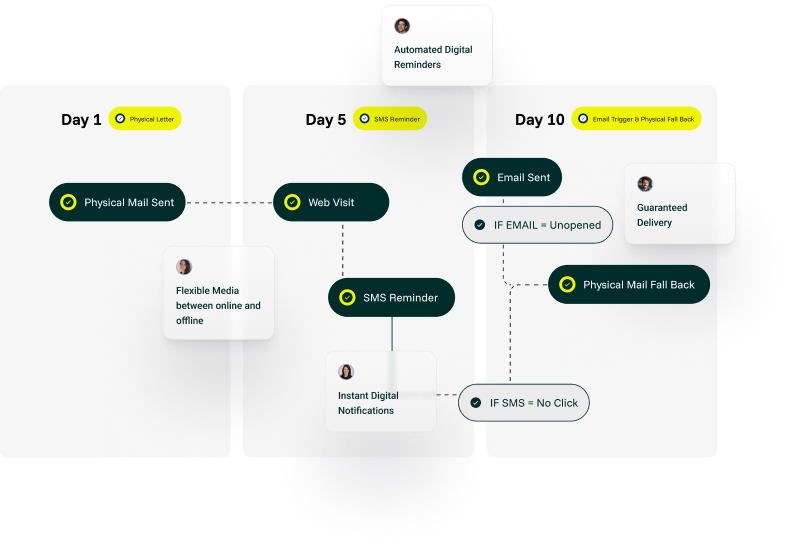
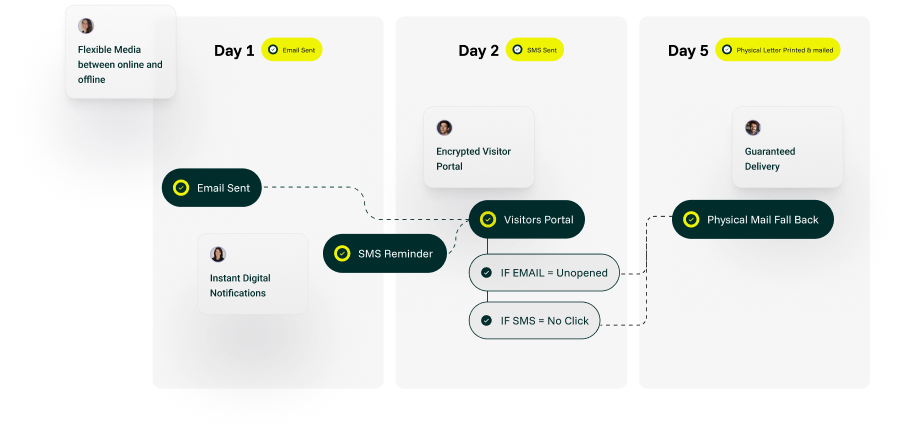
4. Use fallback-to-print for unread digital messages
For regulated or high-risk communication, fallback-to-print is essential. It ensures that critical documents are always delivered, protecting compliance and customer well-being.
The core logic is: Digital-first → If email bounces, is unopened after a defined period (e.g., 7 days), or the customer has a declared print preference → Automatic print and mail.
Fallback-to-print:
- Reduces costs
- Protects compliance
- Ensures no critical communication is missed
- Helps organisations reduce total print volume without taking on risk
This is core to Micom’s multi-channel-intelligent-comms model.
5. Automate workflows to remove operational overhead
Automation reduces:
- Manual data preparation
- Local printing
- Double handling
- SLA failures
- Staff time spent on repetitive tasks. Manual mail workflows often lead to errors like incorrect postage or misclassification, incurring surcharges and delays.
It also improves auditability and accelerates customer communication.
Print vs Hybrid Mail vs Digital: A Comparison for 2026
Sector Spotlight: Protecting Costs Across Industries
Finance and Insurance
High-volume regulatory mail, renewals, arrears, statements.
- Hybrid and digital reduce costs while maintaining auditability.
Utilities and Energy Providers
Billing and reminders create sustained postage volumes.
- Digital notifications can reduce repeat mail and disputes.
Local Government and Public Sector
Budget pressure + statutory responsibilities.
- Multi-channel workflows protect essential services without increasing spend.
Healthcare and NHS
Appointment communications incur large physical volumes.
- SMS and email reminders reduce DNAs and free up print budgets.
How Micom Helps Organisations Reduce Costs in 2026
Micom’s platform allows organisations to manage all outbound communication across print, email, SMS and digital mail, from one intelligent system.
Multi-channel-intelligent-comms
Micom routes each message through the most efficient channel:
- SMS
- Digital mail portal
- Fallback-to-print
This reduces costs while improving speed and reliability.
Secure and compliant
Micom supports:
- ISO 27001
- ISO 9001
- ISO 14001
- Cyber Essentials
- GDPR-aligned workflows
- Banking-grade security
Ideal for regulated sectors.
Real-world savings
Leading UK organisations adopting Micom’s hybrid communication model have reported 35–40 percent cost reductions through reduced print volume and intelligent channel selection (Micom Internal Benchmarking, 2024).
For many businesses, this offsets the impact of rising Royal Mail tariffs entirely.
Frequently Asked Questions
Will Royal Mail definitely increase prices in 2026?
Royal Mail has not yet published its 2026 tariff sheets. However, Ofcom’s review states that further increases are “highly likely” due to financial pressures and falling letter volumes (Ofcom, 2024, Section 4).
Why are stamp prices increasing so quickly?
Falling letter volumes, high network costs and the need to maintain the USO all contribute. Delivering fewer letters across the same nationwide network increases the cost per item.
How can businesses predict their future mailing costs?
Use historic tariff increases, Royal Mail’s pricing patterns and Ofcom’s findings to forecast. Many organisations now model three-year cost estimates to prepare budgets.
Is digital mail legally acceptable?
Yes. For most communication types, digital delivery, including email, SMS or secure portals, is fully compliant with GDPR and regulatory obligations, provided audit trails and proper consent are in place.
What is hybrid mail?
Hybrid mail allows teams to send mail digitally while a secure provider manages print and postage. It reduces operational overhead and often reduces cost per item.
Which industries are most exposed to rising postage costs?
Finance, insurance, utilities, healthcare and the public sector, due to high volumes of compliance-critical documents.
How can automation help prevent postage errors?
Automated mailing platforms correctly classify, weigh, and apply postage to every item digitally, removing the high risk of human error and resulting surcharges that are common in manual workflows. This eliminates the uncertainty of What happens if you put the wrong stamp on a letter.
Summary: Preparing for a Higher-Cost Postal Environment
Royal Mail is facing long-term structural challenges, and the pressure on pricing will continue into 2026. For UK organisations, relying solely on traditional print-and-post is no longer sustainable.
Multi-channel communication offers a more efficient alternative.
Hybrid mail, digital delivery and fallback-to-print provide a modern, cost-effective, compliant way to communicate with customers, citizens or patients.
Micom helps organisations modernise without disrupting their core workflows.
With sustained price pressure ahead, now is the moment to rethink how your organisation communicates — and take control of costs before 2026 tariffs arrive.
References
Ofcom (2024). Review of the Regulation of Royal Mail, Sections 2, 4, 5, 7. https://www.ofcom.org.uk/consultations-and-statements
(Pages 10–12 for volume decline)Royal Mail (2025). Tariff Update 2025. https://www.royalmail.com/prices2025
BBC News (2024). “Royal Mail financial and operational pressures.” https://www.bbc.co.uk/news/business
Micom Internal Benchmarking (2024). Cost reduction analysis across 12 clients (n=12).
Related posts
.png)